Customized Stage Funding
Introduced milestone-based payments for contractors: releasing funds in stages as work is completed and verified, reducing fraud and failure risk while growing the contractor network by 10%.

Overview
Upgrade Home Improvement partners with contractors across renovation verticals such as kitchen remodels, roofing, and flooring to simplify contractor financing. As the platform expanded into larger projects like pool construction, it introduced new challenges: larger loan amounts, longer timelines, and greater financial risk if projects stall after funds are released.
To support this expansion, I designed a stage-based funding system that releases payments in phases after contractor work is verified. I led cross-functional collaboration with Product, Operations (internal agents), and Engineering to define requirements across three distinct user experiences. As a result, Home Improvement gained greater visibility into project progress and expanded its capacity to support more complex jobs and fund larger loans.
Platform
Web-app
Desktop
Timeline
Mar 2024 - May 2024
Team
1 Product Designer (Me)
1 Product Manager
3 FE Engineers
Primary Tools
Figma
Userlytics
Heap & Tableau
Initial Discovery
Before defining a solution, I needed a clear understanding of the merchant funding cycle. I partnered with sales and internal operations to map common renovation categories and assess their cost ranges and timelines.

Based on our findings, pool construction emerged as a high-growth opportunity due to its larger project costs and loan sizes. The average pool loan is roughly 45% larger than a kitchen remodel and 2-3 times larger than most interior renovations, contributing significantly more to total loan volume. Expanding into this vertical also allows us to onboard contractors specializing in larger projects, helping grow and diversify our merchant network.
Problem
While pool construction provides a strong growth opportunity, it also introduces new risks:
Longer project timelines
Pool construction can take 3-6 months, which is significantly longer than most interior renovations, delaying project completion and repayment.
Greater financial exposure
Larger loan amounts increase potential losses if a project stalls, encounters unexpected issues, or is abandoned mid-construction.
Greater project complexity
Excavation and infrastructure work can encounter unexpected issues, increasing the risk that projects stall after funds are already released.
Strategy
Home Improvement already supports predefined stage-funding structures where payments are released in fixed percentages based on the contractor's upfront funding needs. However, these structures are limited to two disbursements (e.g., 50/50, 40/60, 30/70), which fails to reflect how larger construction projects actually unfold. Projects like pool construction require additional funding stages aligned with real construction milestones.
To support this, I focused on two key areas:
Customizable funding stages
Design an experience that allows Upgrade agents to configure funding stages based on merchant type and project structure.
Project progress verification
Introduce a verification process that enables both borrowers and Upgrade agents to approve construction progress before funds are released to the contractor.
Goal
My goal is to design a customizable stage-funding experience that reduces financial risk by verifying construction progress before funds are released, enabling Home Improvement to safely support larger, more complex home renovation projects.
Process
Multi-User Workflow
To design the stage funding system, I worked across three connected user flows:
Users
Key Feature
Upgrade Agents
Configure customized stage funding structures and review verification documentation
Contractors
Submit payment requests with documentation verifying project progress
Borrowers
Review project updates and approve payment requests before funds are released to contractors
To illustrate how the system works end-to-end, the following sections walk through each workflow in the order these actions occur, highlighting how the system coordinates agents, contractors, and borrowers throughout the funding process.
Agent Workflow
To understand the agent workflow, I conducted informal feedback sessions with 6 Upgrade agents to learn how they configure stage funding percentages. While the platform supported a few predefined funding structures, it lacked the flexibility needed for agents to align disbursements with more complex project milestones. I designed a configurable workflow that allows agents to create customized funding stages for different contractor types.
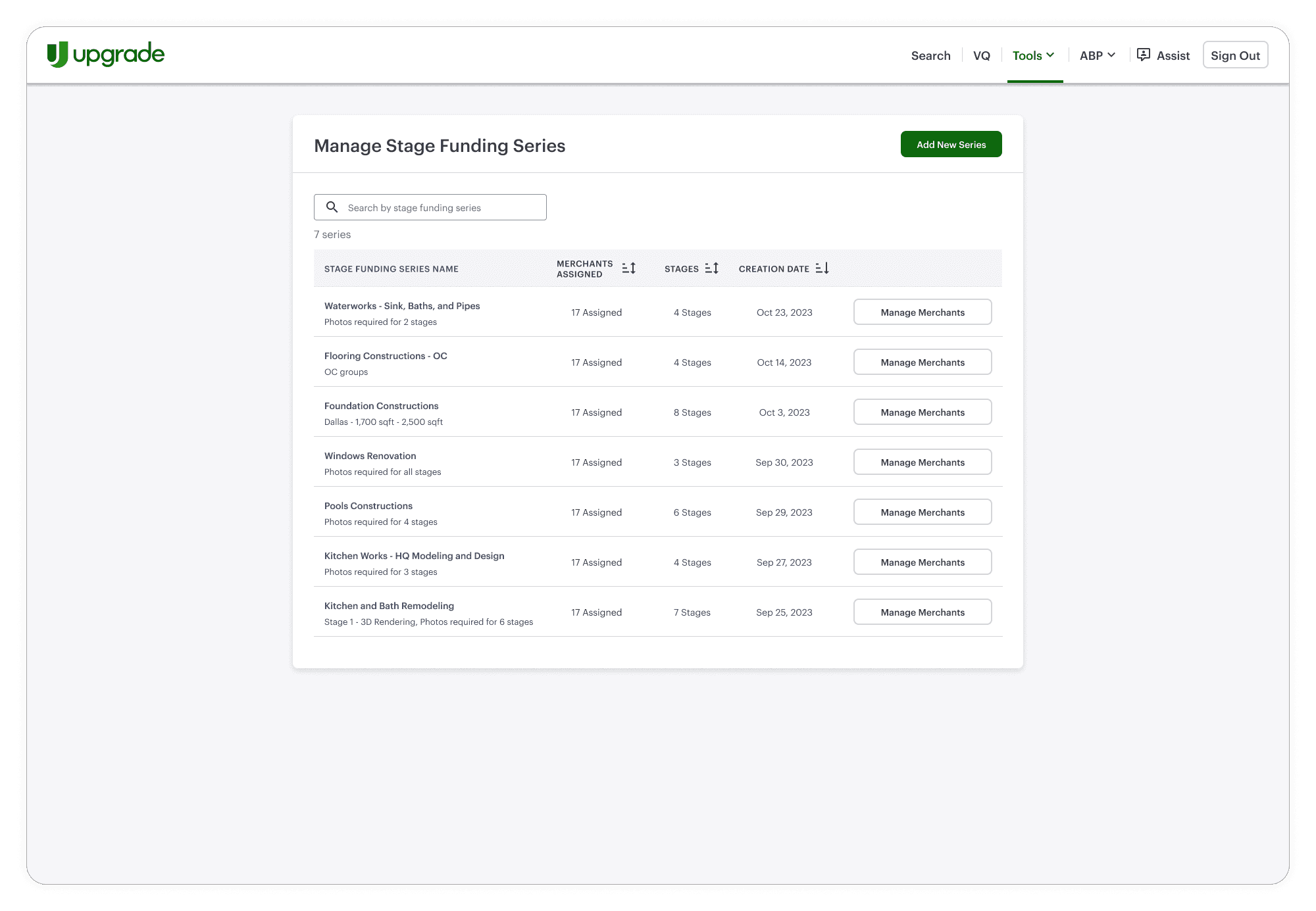
Manage stage funding series
Agents can view all stage funding series in a centralized table. From here, they can create new series, assign contractors to an existing funding structure, or search for specific series as needed.
Create a new stage funding series
Agents create a new stage funding series and define funding stages based on contractor project requirements. Each stage specifies payout percentages and verification conditions for releasing funds.

Assign contractors to a stage funding series
Agents can assign contractors to a stage funding series directly from the management table. This allows the same series to be applied across multiple contractor accounts or branch locations.

Contractor Workflow
While designing the agent experience, I worked closely with sales and compliance partners to define the contractor workflow. Because over 90% of contractors primarily use the platform on desktop, the contractor experience was designed desktop-first.
In the existing payment request experience, contractors only specify the payment amount when submitting a request.

Previous payment request experience
Without structured documentation tied to each project stage, it becomes difficult to track progress or verify completed work. For stages requiring borrower or agent verification, the existing payment request system needs to let contractors submit progress photos tied to project milestones.
Request stage payment
Contractors request payments tied to a specific project stage, creating a structured way to track project progress.

Upload verification photos
Contractors upload photos of the completed stage to confirm work before requesting payment. This helps borrowers and Upgrade agents validate project progress and reduce risk before releasing funds.

Borrower Workflow
After a contractor submitted a payment request, borrowers would review the payment details and approve the request directly. Since more than 70% of borrowers access the platform on mobile, this step was often completed from their phone.
The experience did not include a verification step or require proof of completed work before funds were released. This meant approvals often happened with limited context on the project’s progress. While the flow was simple, it lacked safeguards to confirm that work had actually been completed before payment was approved.

Previous approval experience
Borrower reviews and approves payment requests
Borrower reviews the contractor’s submitted documentation to confirm project progress before approving the payment request. Although this adds an extra step to the flow, the increased friction helps create transparency and trust between borrowers and contractors.

Agent verifies documents through internal portals
When agent verification is required, the request appears in the agent’s internal review queue. Agents review the submitted images as a second verification layer before funds are released.

Takeaways
Results Summary
Within a year of launch, Customized Stage Funding helped Home Improvement onboard over 250 new large contractors. Pool contractors alone now make up 10% of the contractor base, signaling strong demand for financing solutions that support larger, more complex projects.
By tying disbursements to verified construction progress, the platform improves visibility into project progress for both internal teams and borrowers. This reduces risk around larger loan amounts and increases confidence in how funds are released.
With this updated funding framework in place, Home Improvement is now better positioned to expand into new verticals, with Customized Stage Funding providing a scalable foundation for supporting more complex renovation projects.
Challenges
Multi-platform constraints
This system spanned three platforms, each with its own constraints, so much of the work focused on aligning priorities early with PMs and engineering. With tight timelines, we also had to narrow scope and make trade offs between business needs and the ideal user experience.
Compliance limitations
Due to compliance auditing requirements, agents could not edit or delete funding stages once they were created. This made it especially important to design an experience that felt clear and reliable from the start, so agents could move forward confidently,
Stakeholder alignment
Because this system directly affected the sales team’s onboarding workflow, there was a lot of overlapping feedback and competing opinions. I established clear boundaries and led focused feedback sessions across stakeholder groups (sales, compliance, internal agents, etc. ) in order to reduce friction and keep work moving forward.
Next Steps
As Home Improvement continues to grow, we’re refining this experience as we onboard more merchants and uncover new edge cases. The introduction of Stage Funding made it possible to support larger, more complex projects by bringing more structure, visibility, and control to how funds are released.
This foundation also creates opportunities to strengthen operational processes like auditing and risk management, helping Upgrade build a more reliable and compliant lending system.